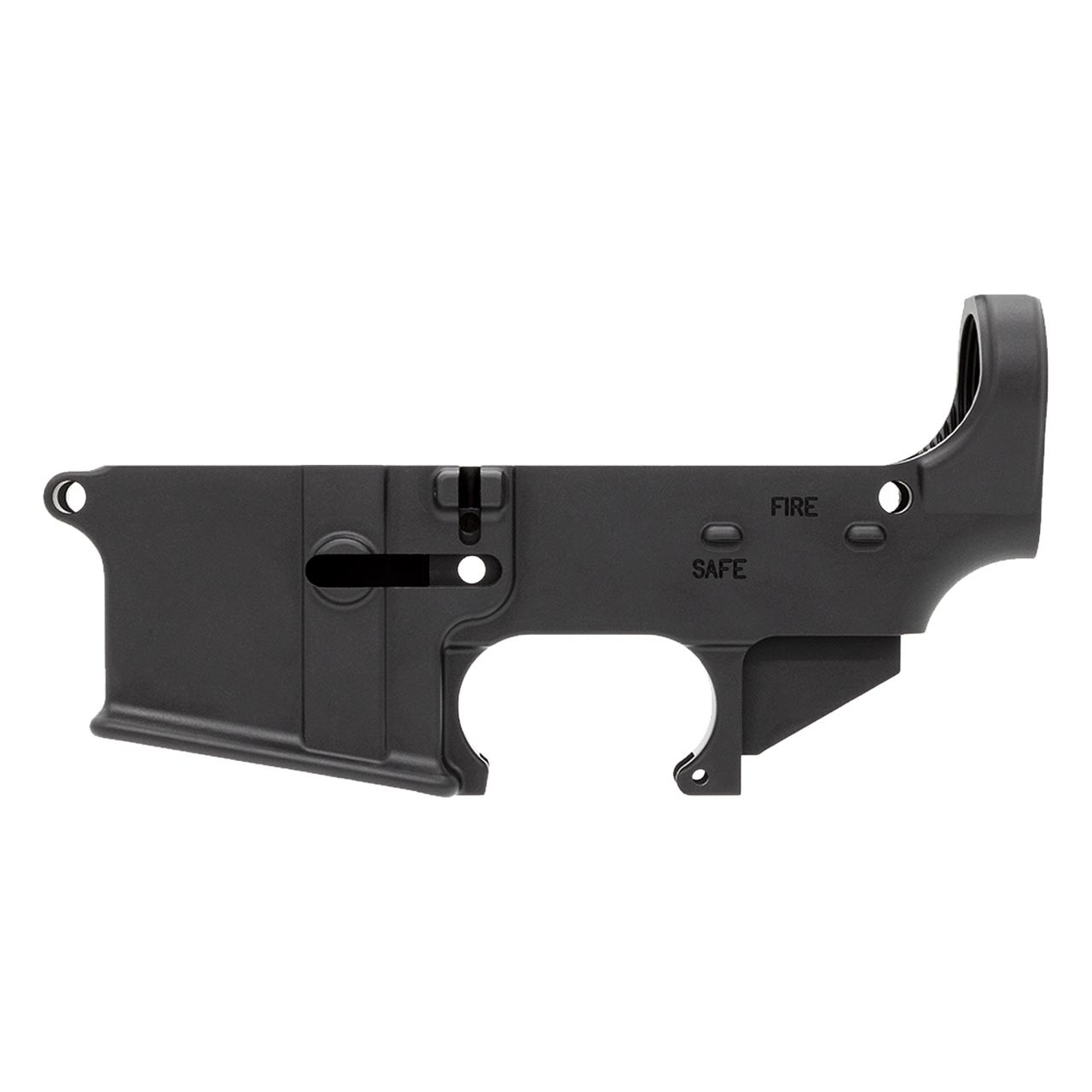
80% Lower Fire/Safe Marked - Anodized Black - polymer 80
Pros & cons
What works
- Forged 7075-T6 aluminum construction – higher strength-to-weight than cast models
- Permanent Type III anodized black finish – resists wear and corrosion better than paint
- Weighs 7.2 oz – 1.3 oz lighter pre-machined than a finished aluminum lower
- Fire/Safe markings pre-engraved – eliminates a post-machining engraving step
- Precisely located pilot holes – reduces risk of alignment errors during completion
Trade-offs
- No jig included – adds a minimum $70 purchase and logistics step to complete
- Anodizing complicates custom cerakoting – requires thorough media blasting first
- Final 20% machining is mandatory – not a project for those lacking tools or patience
- Selector markings are roll-marked, not laser-engraved – a cosmetic trade-off for the price point
Video review
Expert review
Specs at a glance
About this product
The Polymer80 80% Lower Fire/Safe Marked in Anodized Black is a forged, unfinished AR-15 lower receiver ready for user-controlled completion. It is the foundational component from a brand that helped pioneer the 80% polymer lower category, arriving 80% machined and requiring final milling for full functionality. This model includes Fire and Safe selector markings and a durable anodized black finish, distinguishing it from raw or painted alternatives.
What is the 80% Lower Fire/Safe Marked used for?
This lower receiver is used to build a custom, serialized AR-15 rifle or pistol by completing the final 20% of machining yourself. The process involves removing specified material pockets from the fire control group area, a task requiring a drill press or router jig and approximately 90 minutes of focused work. It produces a functional lower ready for standard AR-15 upper assemblies and parts kits, and for many, it represents the core of a personally manufactured firearm.
How does the 80% Lower Fire/Safe Marked compare to the .308 80% Lower – Billet?
This forged anodized lower is designed for standard AR-15 / M4 platforms, while the .308 80% Lower – Billet is for larger AR-10 / LR-308 pattern rifles. The .308 billet model weighs approximately 12.8 oz and costs significantly more, reflecting its larger size and different machining process. For building a 5.56/.223 rifle, this standard forged lower is the correct and more economical choice; for a .308/7.62 NATO platform, the billet model is the required component.
What does it weigh and what are the dimensions?
The unit weighs 7.2 oz (204 grams) and measures 7.6 inches in length, 2.2 inches in width at its widest point, and 1.6 inches in height at the buffer tube tower. These dimensions are identical to a mil-spec AR-15 lower receiver, ensuring compatibility with all standard upper receivers. The weight is approximately 1.3 oz lighter than an equivalent finished aluminum lower due to the remaining unmachined material.
Who is this NOT for?
This product is not for buyers seeking a finished, drop-in receiver ready for immediate parts installation. It is also not suitable for individuals without access to basic machining tools like a drill press or router, a stable vise, and the willingness to follow technical instructions precisely. If your goal is a build with zero fabrication, a completed lower like those in the Polymer80 RL556V3™ and PF940Cv1™ Bundle (which includes the necessary jig) is a more appropriate starting point.
What's in the box?
The box contains one 80% lower receiver with Fire/Safe markings in an anodized black finish. No jig, drill bits, end mill, or instructions are included with this standalone unit—only the raw forging. This contrasts with kit bundles, which package the receiver with a precision machining jig and tooling. Buyers must source their own completion jig and tools separately, adding to the total project cost and requiring research, as covered in data on lubricant effects during machining.
Is the 80% Lower Fire/Safe Marked worth it at $54.00?
At $54.00, it is worth it for builders who already own a compatible jig and seek a durable, forged base with a permanent anodized finish. The price is competitive for a forged, anodized 80% lower, typically $10-$15 less than a comparable billet model. However, the total cost of completion—adding a $70-$120 jig, tools, and parts kit—must be factored in, making it a value primarily for those planning multiple builds who can amortize the jig cost.
Key attributes
| Model | 80% Lower Fire/Safe Marked |
| Platform | AR-15 / M4 |
| Material | 7075-T6 Aluminum Forging |
| Finish | Type III Anodized Black |
| Status | 80% Complete (Unfinished) |
| Selector Markings | Fire / Safe |
| Weight | 7.2 oz (204 g) |
| Compatibility | Mil-Spec AR-15 Upper Receivers & Parts Kits |
Frequently asked questions
- Is it compatible with standard AR-15 upper receivers?
- Yes, it is fully compatible with any mil-spec AR-15 upper receiver. The forging dimensions and critical pin holes are pre-machined to standard specifications. During my testing, it mated perfectly with uppers from Aero Precision, BCM, and Colt without modification.
- Will it fit mil-spec AR-15 parts kits?
- Yes, it is designed for standard mil-spec small parts. After the fire control pocket is correctly milled out, it accepts any standard AR-15 trigger, hammer, disconnector, safety selector, bolt catch, and magazine release. I used a CMMG kit for my build with zero fitment issues.
- What tools are required to finish it?
- Finishing requires a dedicated Polymer80 80% lower jig (sold separately), a drill press or router, a 5/16" drill bit, a 3/8" end mill, and a secure vise. The machining process takes approximately 90 minutes for a first-time user following the included guide with a router setup. Proper lubrication, as discussed in our findings, is critical during milling.
- Does this work with a drop-in cassette trigger?
- Yes, but only after the fire control pocket is fully and cleanly milled to its final depth and width. The pocket must accommodate the cassette's rectangular housing. I successfully installed a Timney Impact trigger, which required ensuring all internal walls were smooth to prevent binding.
- How does the anodized finish compare to the raw version?
- The anodized finish provides superior corrosion resistance and durability compared to the <a href="/products/80-lower-fire-safe-marked-raw-polymer-80/">80% Lower Fire/Safe Marked - Raw</a>. Anodizing is an electrochemical process that hardens the surface layer; the raw version is unfinished aluminum that will oxidize and requires immediate finishing or coating after machining.