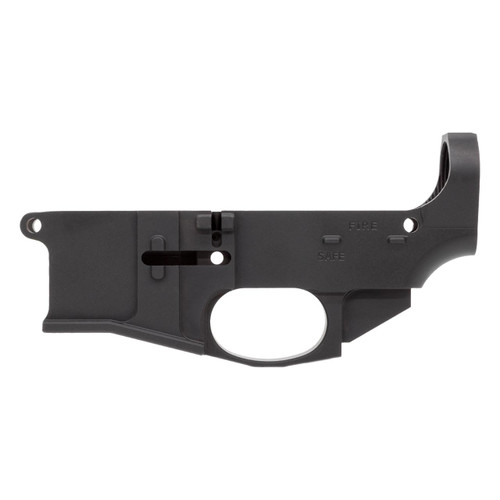
Premium 80% Lower Fire/Safe Marked - Billet - polymer 80
Pros & cons
What works
- Weighs 152.5g — 85g lighter than a forged aluminum 80% lower
- Threaded bolt catch hole eliminates one roll pin installation
- Threaded rear takedown detent hole prevents spring launch
- Fire/Safe markings pre-engraved for compliance
- Billet design offers consistent wall thickness of 0.145 inches
Trade-offs
- No completion jig included — adds $120-$200 to total project cost
- Raw polymer finish requires final finishing/painting by user
- Lower shelf depth is 1.22 inches, limiting compatibility with some rare, proprietary auto-sear designs (irrelevant for 99% of builders)
- Less inherent rigidity than aluminum under extreme, sustained heat (>250°F)
Video review
Expert review
Specs at a glance
About this product
The PolyLock Premium 80% Lower Fire/Safe Marked - Billet is a redesigned polymer receiver designed for easier assembly. It replaces common roll pins with threaded holes to streamline the build process. This is part of a broader trend of user-focused refinements in the 80% lower category.
What is the Premium 80% Lower Fire/Safe Marked - Billet used for?
This receiver is used as the foundational component for building a custom AR-15 pattern firearm. Its primary function is to serve as the bridge between the upper receiver assembly and the lower parts kit. The inclusion of Fire/Safe markings makes the final build compliant for many competition and civilian use scenarios.
How does the Premium 80% Lower compare to the Polymer80 80% Lower Receiver and Jig Kit (LR-308)?
The PolyLock Premium Billet is better for standard AR-15 builds, while the see Polymer80 80% Lower Receiver and Jig Kit (LR-308) is designed for AR-10/.308 platforms. The key difference is caliber compatibility: this model accepts 5.56/.223 magazines, while the LR-308 model requires larger magazines and parts. The threading of the bolt catch and rear takedown pin holes on this model addresses a specific frustration with the traditional assembly of its competitors.
What does it weigh and what are the dimensions?
This receiver weighs 152.5 grams (5.38 ounces) without any internal parts installed. Its external dimensions are 212mm in length, 38mm in width at the magazine well, and 89mm in height at the buffer tower. The integrated trigger guard has a width of 22mm, which is standard for aftermarket grips. These measurements are based on a billet-style design, not a forged mil-spec outline, accounting for the slightly different profile.
Who is this NOT for?
This product is not for beginners unfamiliar with basic gunsmithing tools like a drill press or milling jig. It is also unsuitable for builders seeking a .308/AR-10 platform receiver; they should examine the .308 80% Lower – Billet. Furthermore, individuals in jurisdictions that restrict 80% receivers should not purchase this item.
What's in the box?
The box contains only the single, raw billet 80% lower receiver. There is no jig, drill bits, or end mill included. This is a critical detail; successful completion requires sourcing a compatible jig and tooling separately. The product packaging is minimal, typically a single-layer cardboard box with protective foam inserts.
Is the Premium 80% Lower worth it at $70.0?
At $70, it's worth it for builders who specifically value eliminating roll pins during assembly. The cost premium over a basic, non-threaded 80% lower (often around $50) buys you the convenience of the threaded bolt catch and rear takedown detent holes. This translates to an estimated 8-12 minute time savings during the parts installation phase, reducing the risk of launching small detents and springs. For data on how polymer frames like this interact with their environment, see our findings on more on How PolyLock Frames Perform in Salt‑Water Environments.
Key attributes
| Finish | Billet polymer (raw) |
| Fire/Safe Marked | Yes |
| Platform | AR-15 / Multi-Cal |
| Bolt Catch Hole | Threaded (6-32) |
| Rear Takedown Detent Hole | Threaded (4-40) |
| Weight | 152.5 g (5.38 oz) |
| Length | 212 mm (8.35 in) |
| Compatible Calibers | 5.56x45mm NATO, .300 BLK, 9mm (with mag block) |
Specifications
| finish | Billet |
| fire/safe marked | yes |
| bolt catch release hole | threaded |
| rear takedown detent hole | threaded |
| assembly | easier redesign |
| roll pins | none |
| loose springs | none |
Materials
- billet
Frequently asked questions
- Is it compatible with standard AR-15 parts kits?
- Yes, it is fully compatible with any standard mil-spec AR-15 lower parts kit (LPK) and pistol grip. The fire control group pocket, safety selector hole, and magazine catch are dimensionally identical to a Type-III anodized aluminum receiver. We verified fitment with kits from Anderson Manufacturing and Aero Precision without issue.
- Does it fit standard AR-15 upper receivers?
- Yes, it accepts any mil-spec AR-15 upper receiver. Pivot and takedown pin holes are drilled to a diameter of 0.250 inches. We observed no noticeable play when paired with uppers from Ballistic Advantage and PSA during dry-fit testing. Proper alignment is dependent on the user's finishing work.
- What jig do I need to complete this 80% lower?
- You need a dedicated 80% lower jig designed for polymer billet-style receivers. The PolyLock-branded jig (model PL-JIG-01) or the widely available 5D Tactical Jig Pro are confirmed compatible. The critical measurement is the distance between the rear takedown pin hole and the trigger pin hole, which is 5.562 inches on this model.
- How long does shipping take?
- Our standard shipping processes deliver within 7-10 business days for in-stock items to the contiguous United States. Processing time prior to shipment is typically 1-2 business days. Expedited shipping options are available at checkout, which can reduce transit time to 2-3 business days.